



2025 in review — records broken, narratives shifted
2025 was a defining year for DDoS defence, both in scale and visibility. For FastNetMon, it was also a year where our detections and analysis consistently surfaced in the wider security conversation.
Attacks detected by FastNetMon were covered by The Register, SC Media, CybersecurityNews, and BleepingComputer, while Fortune highlighted several of the botnets we tracked closely. Bloomberg featured our technical commentary when analysing some of the year’s most high-profile incidents. This visibility reflects how DDoS activity has moved from a niche operational concern to a topic with clear economic and geopolitical implications.
Record-breaking attacks became routine
If there is one theme that defined 2025, it was scale. Seven record-breaking DDoS attacks were reported or alleged over the course of the year. By comparison, the widely reported 2024 record attack — a 5.6 Tbps UDP flood — now seems very modest. By late 2025, the latest confirmed record had reached 29.7 Tbps, fundamentally changing assumptions around capacity planning, upstream dependencies, and mitigation design.
Vulnerabilities, exposure and the return of fundamentals
Alongside headline-grabbing attacks, 2025 also highlighted exploitable infrastructure weaknesses. Botnets leveraged both known and zero-day vulnerabilities in industrial routers, Mitel phones, Junos OS, HTTP/2 implementations, Windows zero-click paths, and SSH-exposed Linux systems. These events reminded the community that attackers continue to succeed by combining well-understood weaknesses with automation and scale.
What caught the community attention — FastNetMon News in 2025
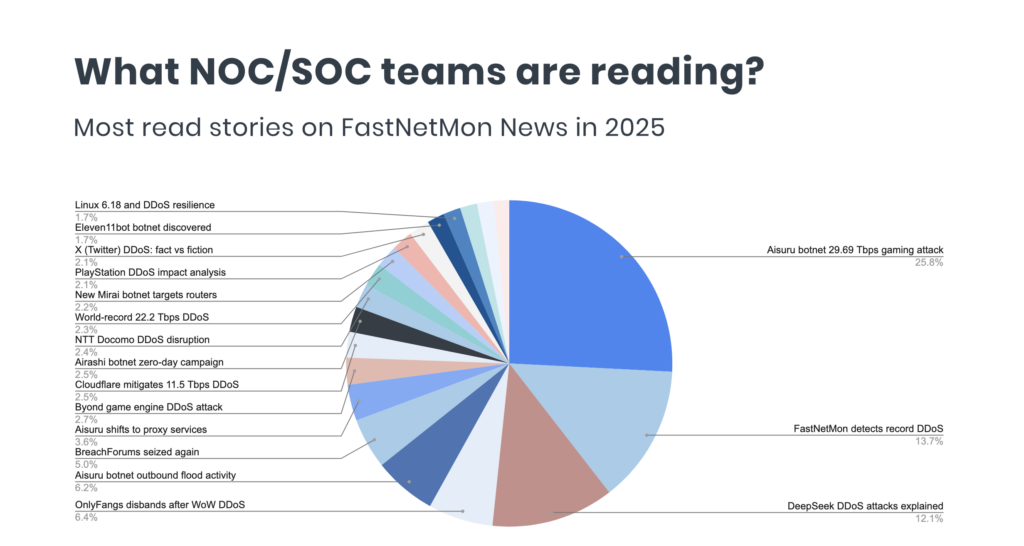
Over the past year, FastNetMon reported over 120 DDoS-focused news topics, covering attacks, botnets, vulnerabilities, and mitigation insights. Remarkably, there was not a single week without an incident or noteworthy development. The network engineering and security community has closely followed this coverage, with the top 20 stories illustrated in this pie chart of reader interest:

Dominance of volumetric attacks
The stories attracting the highest engagement focused on hyper-volumetric DDoS attacks, particularly the Aisuru botnet. The report on the 29.69 Tbps gaming-targeted attack alone received over a quarter of our blog views.
Beyond raw bandwidth numbers, several incidents dominated industry discussion. High-profile attacks against DeepSeek, or the alleged attack on X (formerly Twitter), illustrated different facets of recent DDoS activity — from large-scale disruption to smoke and mirrors PR stories. The Azure-related attack reinforced that even hyperscale environments are not immune to persistent, high-volume campaigns.
More recently, the coordinated pre-Christmes attack on French national postal services and online banking platforms, recently claimed by NoName057(16), became one of the year’s most disruptive incidents, noted for both timing and societal impact.
Botnet evolution stories and platform vulnerabilities
Coverage of Aisuru’s shift to proxy services, discoveries of new Mirai variants, Eleven11bot, and Rondodox, as well as zero-day exploitation campaigns like Airashi, showed strong community interest in botnet evolution and secondary use. Meanwhile, posts detailing vulnerabilities and infrastructure, such as Linux 6.18 resilience and Junos BGP reset vulnerability — emphasised engineers’ appetite for practical, actionable insights.
Engineering insight and community favourites
FastNetMon’s blog is not just about news. Our posts provide engineering guides, topical analysis, and explanatory content that help teams understand both the mechanics of attacks and practical mitigation strategies. The top 20 most-read blog topics are shown in the accompanying pie chart:
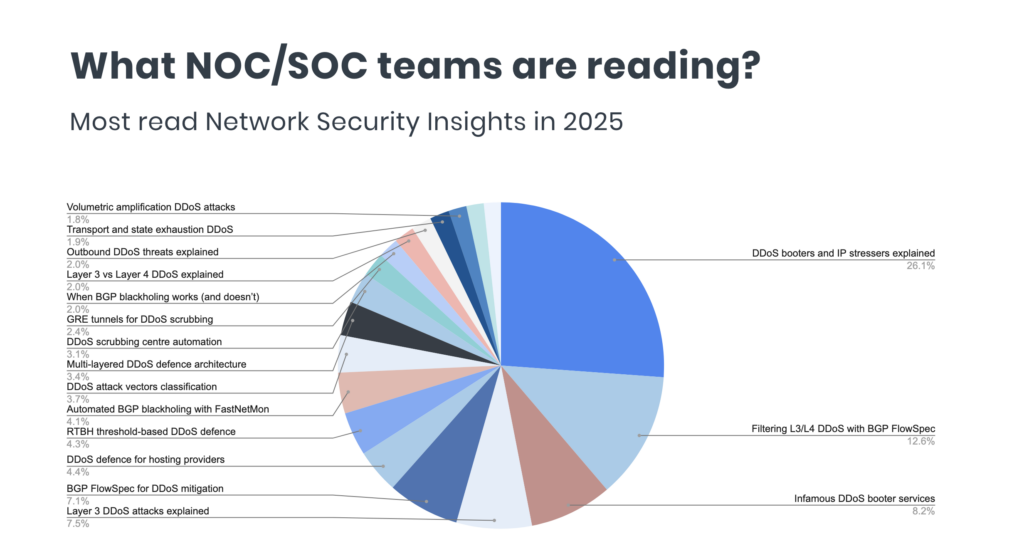
Leading the list was our article on DDoS booters and IP stressers, reflecting the community’s need for foundational knowledge of where the large scale volumetric attacks originate. Guides on L3/L4 DDoS filtering with BGP FlowSpec, and RTBH or automated blackholing showed a strong interest in operational, implementable solutions.
Technical deep dives – especially from our widely published DDoS classification seres – covering attack vectors such as volumetric amplification to transport and state exhaustion made it to the top 20 of most read articles. And possibly, along with the changing defence landscape and need for specific solutions, the community did read our DDoS scrubbing centre automation quite thoroughly.
Overall, this mix confirms that actionable engineering knowledge, attack analysis, and explanatory content resonate strongly with the community — a trend we will continue to prioritise next year.
Looking ahead — community, insight, action
As 2025 draws to a close, FastNetMon is proud of the role our coverage has played in keeping the network engineering and security community informed. From record-breaking DDoS floods to emerging botnet behaviour, our reporting has aimed to be timely, factual, and practical, giving NOC and SOC teams the insight they need to take effective action.
FastNetMon’s news and intelligence arm remains committed to being a community-oriented, unbiased source, highlighting what matters in the DDoS landscape without sensationalism. Our goal is to help professionals not only respond to incidents but also anticipate threats, understand evolving attack patterns, and strengthen their networks.
Looking ahead to 2026, we plan to expand our activities even further — with more high-quality analysis, engineering insights, and more channels for you to follow our work. But for now, we thank our readers for their engagement and curiosity, and wish everyone a safe and resilient New Year!
About FastNetMon
FastNetMon is a leading solution for network security, offering advanced DDoS detection and mitigation. With real-time analytics and rapid response capabilities, FastNetMon helps organisations protect their infrastructure from evolving cyber threats.For more information, visit https://fastnetmon.com.