As we move through 2026, IPv6 adoption continues to increase steadily across service provider networks, enterprise backbones, and mobile infrastructures. However, IPv4 is still far from disappearing in practice. A large portion of global internet traffic, applications, and legacy services continues to rely on IPv4 connectivity, which means operators must still maintain mechanisms to bridge IPv4 and IPv6 environments.
This has led to continued interest in transition technologies that allow operators to simplify their core networks while still supporting IPv4 access. One of these mechanisms is MAP-T (Mapping of Address and Port using Translation), which is designed to support IPv4 connectivity over an IPv6-only infrastructure without requiring per-connection state in the core.
In this article, we will first take a closer look at how MAP-T actually works in practical terms. After that, we will shift the focus to something more relevant to 2026 operator discussions: how MAP-T behaves in real deployments, what trade-offs engineers report, and why many of the interesting questions are operational rather than protocol-level.
Understanding MAP-T: how IPv4 works over an IPv6-only core
MAP-T, defined in RFC 7599, is a stateless mechanism for transporting IPv4 traffic across an IPv6-only network using deterministic translation rules.
At a high level, MAP-T exists to solve a specific problem: how to allow IPv4 communication to continue working when the provider network itself has removed IPv4 from its internal infrastructure.
Instead of maintaining large state tables like Carrier-Grade NAT systems, MAP-T relies on a pre-defined mapping function. This function allows both the customer-side device and the provider-side gateway to independently calculate how IPv4 addresses and port ranges correspond to IPv6 addressing.
The key idea: shared IPv4 + port partitioning
In a typical MAP-T deployment, multiple customers share a single IPv4 address. What distinguishes one customer from another is not the IPv4 address itself, but the range of ports assigned to them.
Each subscriber is given:
- a shared IPv4 address
- a specific subset of transport-layer ports, defined by a Port Set ID (PSID)
This means that IPv4 addressing becomes less about unique addresses and more about structured sharing of both address and port space.
These parameters are then embedded into the IPv6 address structure using what are known as Embedded Address (EA) bits. This embedding allows the network to carry enough information within IPv6 packets to reconstruct the original IPv4 context when needed.
A simplified way to think about this mapping is:
IPv6 address = IPv6 prefix + embedded IPv4 + port-set identifier + interface identifier
This is not a literal packet format, but it is a useful conceptual model for understanding how MAP-T preserves IPv4 semantics inside an IPv6-native environment.
The role of Customer Edge and Border Relay
MAP-T deployments are typically built around two functional components.
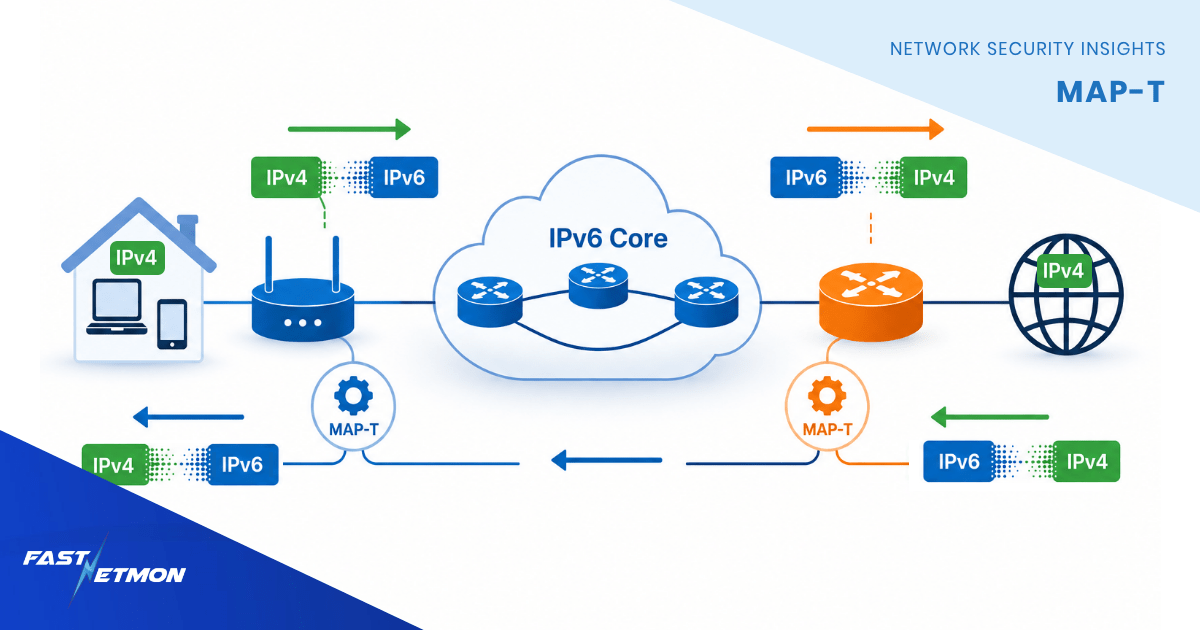
The first is the Customer Edge (CE), which is usually the subscriber’s home or enterprise router. The CE is responsible for applying local translation rules and ensuring that outgoing traffic conforms to the assigned IPv4 address and port range.
The second is the Border Relay (BR), which sits at the edge of the service provider network. The BR is responsible for translating traffic between the IPv6-only core and the external IPv4 Internet.
Because both sides use the same deterministic mapping rules, the system does not require per-session state. Instead, it relies entirely on address structure and rule consistency.
Packet flow in practice
When a device sends traffic, the Customer Edge first translates private IPv4 traffic into the assigned shared IPv4 space using NAT44. After this step, the packet is translated into IPv6 using MAP-T rules and forwarded into the provider’s IPv6-only core network.
Within the core, the traffic is treated as native IPv6 and does not require any IPv4 routing capability.
When return traffic arrives, the Border Relay uses the destination IPv4 address and port combination to determine which subscriber the traffic belongs to. It then applies the same mapping logic in reverse, reconstructing the correct IPv6 destination and forwarding the packet to the appropriate Customer Edge device.
The important property here is determinism: both sides independently arrive at the same mapping decision without exchanging state information.
What operators actually talk about in 2026 MAP-T deployments
While the mechanism itself is relatively straightforward, most operator discussions in 2026 are not focused on the protocol design. Instead, they revolve around operational trade-offs, deployment constraints, and real-world behaviour under scale.
In practice, MAP-T is less of a theoretical design discussion and more of a “how does this behave in my environment” topic.
1. Stateless forwarding vs operational state reality
One of the first clarifications that often appears in operator conversations is that “stateless” refers only to packet forwarding behaviour in the core network.
In reality, operators still maintain a significant operational state, including:
- Port Set ID allocations per subscriber
- Mapping rule consistency across provisioning systems
- Coordination between DHCP, BNG, and translation systems
- Troubleshooting metadata for support and engineering teams
This leads to a subtle but important distinction that is frequently discussed in ISP engineering groups:
MAP-T removes per-flow state from the forwarding plane, but it does not remove the need for structured state in the operational and provisioning layers.
In other words, the network becomes simpler in one dimension, but more structured in another.
2. Port allocation becomes a design constraint, not just a detail
In operator discussions, port allocation is one of the most practical constraints in MAP-T design.
Because each subscriber receives only a subset of the available port space, operators must carefully balance:
- IPv4 address efficiency
- expected user behaviour
- application requirements
- support overhead
In real deployments, issues rarely come from steady-state traffic. Instead, they tend to emerge from burst behaviour, where a user temporarily exceeds expected connection patterns.
This leads to a recurring engineering question in operator forums:
How aggressively can we share IPv4 addresses before port constraints become visible to end users?
MAP-T does not remove this constraint; it makes it explicit and structurally enforced.
3. Customer equipment remains a persistent operational limitation
Another consistent theme in 2026 deployment discussions is customer-premises equipment compatibility.
Even though MAP-T is conceptually clean in the core network, it requires correct implementation at the edge device. In practice, operators frequently encounter challenges such as:
- inconsistent vendor support across router firmware versions
- limited availability of MAP-T-capable consumer devices
- difficulties supporting customer-owned hardware
- operational overhead in managing firmware fragmentation
As a result, MAP-T deployments tend to work best in environments where operators control the customer edge device, or where equipment is tightly standardised.
This is one of the reasons MAP-T is not universally deployed, even when it is architecturally attractive.
4. MAP-T vs MAP-E: an ongoing operational preference debate
Although MAP-T and MAP-E are closely related in design, operators often prefer one over the other based on operational experience rather than theoretical efficiency.
MAP-T is typically described as more “native” to IPv6 networks, since it avoids encapsulation and operates through translation alone. However, this also means that packet reconstruction and debugging require deeper awareness of mapping rules.
MAP-E, by contrast, uses encapsulation, which some operators find easier to troubleshoot because IPv4 packets remain intact inside IPv6 transport.
A common summary from engineering discussions is:
MAP-T tends to be preferred for architectural cleanliness, while MAP-E is often preferred for operational simplicity.
5. Observability is more complex than the stateless model suggests
One of the more subtle findings from operator discussions in 2026 is that stateless forwarding does not automatically translate into simpler observability.
Because IPv4 headers are translated and partially embedded into IPv6 structure, troubleshooting often requires:
- access to mapping rule definitions
- correlation between IPv4 and IPv6 address spaces
- understanding of Port Set ID allocation logic
This means that packet-level debugging can be less intuitive than in either pure IPv4 or dual-stack environments.
To address this, operators often implement additional tooling around MAP-T deployments, including enhanced telemetry at Border Relays and internal systems that reconstruct subscriber identity from flow data.
6. MAP-T is typically a later-stage transition mechanism
In most 2026 deployments, MAP-T is not the first step in IPv6 transition strategy.
Instead, operators typically progress through stages such as dual-stack deployment, CGNAT introduction, and gradual exploration of IPv6-only core designs using different transition technologies.
MAP-T is usually considered when operators are explicitly trying to reduce IPv4 dependency in the core while maintaining deterministic control over address sharing and port allocation.
This positions MAP-T as a refinement stage rather than an initial adoption tool.
Final thoughts
MAP-T is best understood not simply as a translation mechanism, but as part of a broader operational shift in 2026 network design. It replaces per-flow state with deterministic mapping rules, enabling IPv6-only core architectures while preserving IPv4 connectivity.
However, the real-world experience of MAP-T is shaped less by its protocol design and more by operational realities: port allocation strategy, customer equipment constraints, observability requirements, and the complexity of large-scale ISP environments.
In that sense, MAP-T does not eliminate complexity — it redistributes it. And in 2026 operator discussions, that redistribution is exactly where the most interesting engineering debates continue to happen.