Network operators have more routing data available today than ever before. Yet in practice, the data is still scattered across multiple tools, external services, and ad hoc workflows.
When investigating a routing incident, engineers typically move between BGP lookup services, RPKI validators, IRR databases, WHOIS tools, historical route collectors, and internal monitoring systems. Each provides part of the picture, but none provide the full operational context.
This fragmentation is where Netomics comes in.
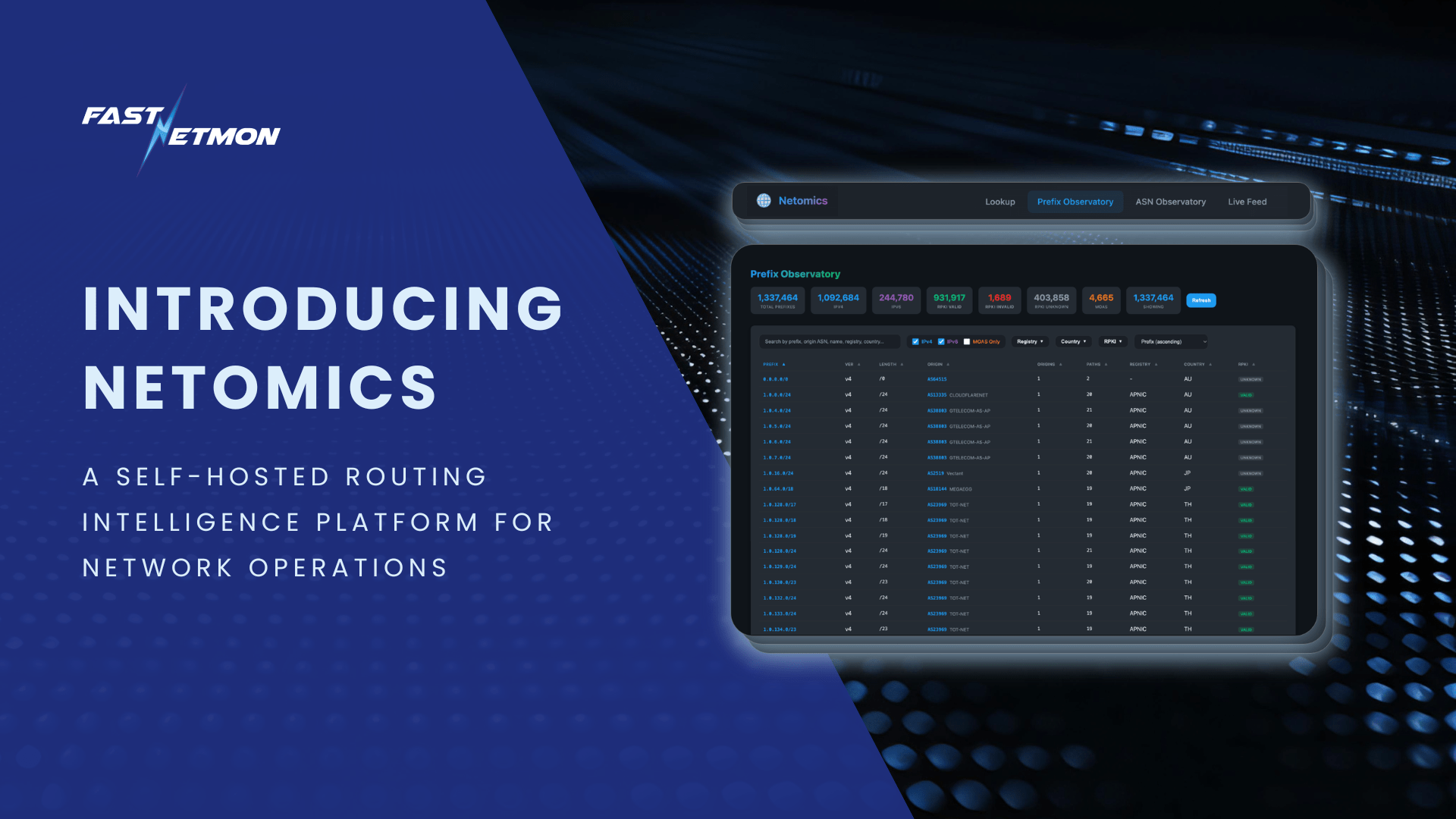
Netomics is a self-hosted BGP routing intelligence platform that brings together live routing data, registry information, routing history, validation systems, and AI-assisted querying into a single operational environment — deployed entirely inside the operator’s own infrastructure.
Why we built Netomics
At FastNetMon, we work closely with ISPs, cloud providers, IXPs, and large enterprises operating complex networks. One pattern has been consistent for years: routing visibility is not the problem. Routing context is.
Operators already have access to BGP feeds, telemetry, and monitoring systems. The challenge is that answering even simple operational questions often requires correlating multiple external and internal data sources.
For example:
- Who originates this prefix right now?
- Has this route been seen before?
- Is the announcement RPKI valid?
- How has this ASN behaved historically?
- Is this a known customer, peer, or upstream?
- Is this a new or abnormal routing path?
These questions are fundamental to operations and security, yet they are typically answered by jumping between tools and manually stitching data together.
Netomics was built to remove that friction.
A unified routing intelligence model
Netomics aggregates multiple routing data sources into a single, queryable system:
- Live BGP and BMP feeds
- Historical routing state and changes
- ASN and prefix ownership data
- Regional Internet Registry (RIR) data
- WHOIS records
- Internet Routing Registry (IRR) data
- Geofeed information
- RPKI validation
- ASPA (Autonomous System Provider Authorisation) status
Instead of treating these as separate systems, Netomics builds a unified model of routing intelligence that can be queried consistently across all datasets. The result is more than visibility. We are building for contextual routing understanding.
Real-time routing visibility
Traditional routing analysis systems are often snapshot-based or delayed. Netomics is designed around live ingestion of BGP Monitoring Protocol (BMP) feeds directly from routers.
This enables operators to observe routing changes as they happen, rather than reconstructing them after the fact.
In operational terms, this means:
- Faster detection of routing anomalies
- Immediate visibility into prefix origin changes
- Real-time understanding of AS path evolution
- Improved response time during incidents
For large networks, this shift from “post-event analysis” to “live understanding” is critical.
Self-hosted by design
One of the core design decisions behind Netomics is that it runs entirely inside the operator’s infrastructure.
This means:
- No external API dependencies
- No rate limits
- No data leaving the network
- No reliance on third-party uptime
- Full control over routing intelligence
Netomics is designed to become part of internal network operations infrastructure, with compliance and operator control built in.
Built for automation and AI-assisted operations
Modern network operations are increasingly automated, and Netomics is designed with that reality in mind.
The platform exposes routing intelligence through:
- REST APIs for integration with internal systems
- Bulk lookup interfaces for large-scale analysis
- Prometheus metrics for observability pipelines
- Streaming interfaces for real-time systems
- Model Context Protocol (MCP) support for AI assistants
The inclusion of MCP support is particularly important: it allows AI systems such as ChatGPT or Claude to directly query live routing data within a controlled, self-hosted environment.
This enables new workflows such as:
- AI-assisted incident triage
- Natural language routing queries
- Automated anomaly investigation
- Context-aware operational assistants
Rather than replacing existing tooling, Netomics becomes a routing intelligence layer that automation and AI systems can build on.
Security and routing validation
Routing security remains one of the most critical challenges in Internet operations.
Netomics integrates RPKI validation and routing registry data directly into its core model, enabling operators to:
- Validate route origin authenticity
- Identify invalid or suspect announcements
- Detect potential hijack scenarios
- Monitor Multi-Origin AS (MOAS) events
- Correlate routing changes with registry intent
This is particularly valuable in environments where routing decisions have direct operational or financial impact.
A platform, not just a lookup tool
While many tools focus on BGP lookups or individual datasets, Netomics is designed as an operational routing intelligence platform.
It is intended to sit alongside existing infrastructure systems and become a central reference point for routing truth within an organisation.
This makes it relevant across multiple teams:
- Network Operations Centres (NOCs)
- Security Operations Centres (SOCs)
- Cloud networking teams
- Platform engineering teams
- IXP route policy teams
Each of these groups interacts with routing data differently, but they share a common need: reliable, contextual, and real-time routing intelligence.
Availability
Netomics is available now for deployment within customer infrastructure.
Selected capabilities can be explored at:
Full deployments are provided for ISPs, IXPs, cloud providers, and enterprises requiring internal routing intelligence systems.