Occasionally on the FastNetMon blog, we venture into the history of communications infrastructure and the engineering stories that helped shape the Internet we know today. This time, it’s the remarkable story of how Victorian engineers attempted to wire an ocean—and what happened when their first transatlantic connection lasted only a few weeks.
On August 16, 1858, Queen Victoria sent a message to U.S. President James Buchanan. The message itself was conventional diplomatic fare, expressing goodwill between Britain and the United States. What was extraordinary was the route it took.
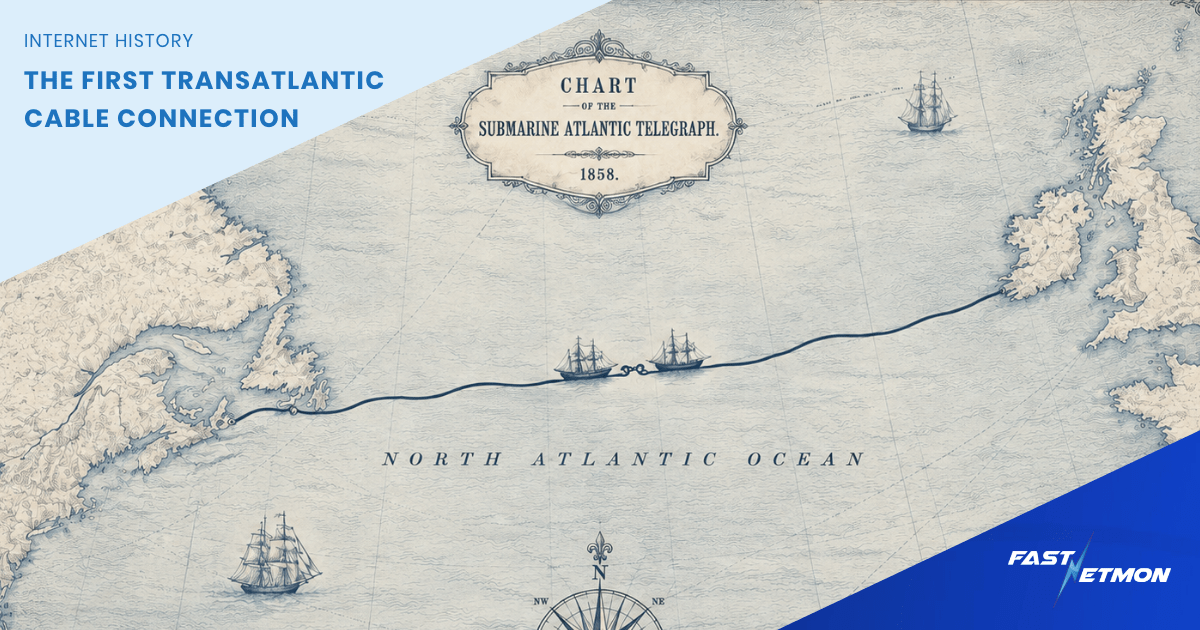
Instead of travelling aboard a ship, the message crossed the Atlantic as electrical signals through roughly 3,200 kilometres of cable connecting Ireland and Newfoundland. Victoria's 98-word message took almost 16 hours to transmit. That sounds painfully slow today, but a steamship carrying the same information could take around ten days to cross the Atlantic.
For the first time, information could travel between Europe and North America without a person, letter or ship making the journey. It was a profound change in what distance meant, and the public response reflected it. The project has since been described as the Victorian equivalent of the Apollo mission.
There was, however, a rather serious problem with this technological triumph. Within a few weeks, the cable had stopped working.
The story of the first transatlantic cable is therefore not simply one of Victorian ingenuity. It is also a remarkably familiar engineering story: an ambitious idea pushed beyond the limits of existing technology, competing theories about how to make it work, repeated deployment failures, difficult debugging, questionable design decisions and enormous financial pressure. Most importantly, it is a story about learning from failure.
Connecting two continents
Electrical telegraphy was already well established by the 1850s. Telegraph networks had spread across land, while shorter submarine cables had demonstrated that electrical signals could also be transmitted underwater. A cable between Britain and France had been laid as early as 1850.
Crossing the Atlantic was an entirely different proposition. The distance between Ireland and Newfoundland was thousands of kilometres, with parts of the route crossing ocean around two miles deep. A cable would have to be manufactured in unprecedented quantities, carried across the Atlantic, lowered onto an ocean floor nobody could directly observe, and remain electrically functional after deployment.
The driving force behind the project was an American businessman named Cyrus W. Field. Having made his fortune in the paper industry, Field became interested in telegraphy and eventually turned his attention to connecting North America with Europe. In 1856, he joined English submarine-telegraph specialists John Watkins Brett and Charles Tilston Bright to form the Atlantic Telegraph Company.
It was a serious commercial undertaking. The company raised around £350,000 in private capital, much of it from British business communities, while both the British and U.S. governments provided financial support and ships. The ambition was enormous, but so were the unresolved engineering questions.
Nobody had ever built a communications link of this length.
Designing a cable for an ocean
The basic construction of the cable would be recognisable to a modern communications engineer. At the centre was the conductor: seven strands of copper wire twisted together. Around this were three layers of gutta-percha, a natural latex derived from tree sap that provided electrical insulation. Tarred hemp and an outer wrapping of iron wire provided additional protection and mechanical strength.
The completed cable was approximately five-eighths of an inch in diameter and weighed more than a ton per nautical mile. Producing enough of it was itself a major industrial undertaking; no single manufacturer could deliver the required quantity within the available time, so the order had to be divided.
More significantly, engineers disagreed about what the cable's electrical characteristics should be.
Edward Orange Wildman Whitehouse, an electrician working for the Atlantic Telegraph Company, supported a relatively thin conducting core. William Thomson, the physicist who would later become Lord Kelvin, argued in favour of a substantially larger conductor made from extremely pure copper. Charles Bright, the project's chief engineer, agreed with Thomson.
The difference between the proposals was substantial. The copper core that was ultimately manufactured weighed about 107 pounds per nautical mile. Thomson and Bright had proposed a core weighing approximately 392 pounds per nautical mile.
The lighter design was adopted.
Even at that weight, transporting the completed cable created another practical problem: no ship could carry all of it. The load therefore had to be divided between two naval vessels, HMS Agamemnon, a British warship launched in 1852, and the American Niagara.
The plan now depended on getting thousands of kilometres of cable from those ships to the seabed without losing it along the way.
The first attempt
The first major expedition began from Ireland on August 5, 1857. The initial plan was to start at the Irish coast and gradually pay the cable out from Niagara while sailing west across the Atlantic.
Problems appeared almost immediately. Less than five miles from shore, the heavily reinforced shore section of the cable became caught in the machinery and broke. The expedition managed to retrieve it, splice it back together and continue.
That early failure demonstrated how difficult the physical act of laying the cable would be. The cable could not simply be dropped over the stern. Its release had to be carefully controlled while accounting for the speed of the ship, ocean currents, waves and the increasing weight of cable suspended between the vessel and the seabed. Machinery controlled the rate at which cable was paid out, with brakes requiring continual adjustment.
In calm weather this was manageable. The North Atlantic was not reliably calm.
At around 3:45 a.m. on August 11, Niagara moved into the trough of a wave. As the ship rose again, tension on the cable increased. The brakes should have been released to compensate, but they were not. The cable broke and disappeared into water so deep that it could not be recovered.
The expedition was abandoned for the year.
A second attempt — and several more failures
The winter provided an opportunity to improve the system. Engineer William Everett redesigned the paying-out machinery, paying particular attention to its braking mechanism and safety features, while the crews practised the procedures they would need at sea.
Thomson was also working on the electrical problem. He developed his mirror galvanometer, a highly sensitive instrument capable of detecting extremely faint electrical currents. This would become important because sending a signal through thousands of kilometres of submarine cable was not simply a matter of applying enough voltage at one end and expecting a clean pulse to appear at the other.
When the ships returned in 1858, they adopted a different deployment strategy. Instead of starting at Ireland, Agamemnon and Niagara would sail to the middle of the Atlantic carrying half the cable each. There the crews would splice the two halves together before the ships sailed in opposite directions, Agamemnon towards Ireland and Niagara towards Newfoundland.
Before they could even begin, a six-day storm battered the cable-laden ships. Agamemnon, carrying around 1,500 tons of cable, rolled violently enough that 45 men were injured, and the vessel was pushed approximately 200 miles off course.
Eventually, on June 25, the two ships met and joined their cables. They began sailing apart, initially communicating with each other through the new connection. Two days later, the electrical connection failed. Both ships returned to the rendezvous point, abandoned the cable already laid and started again.
The next attempt ended with another broken cable.
For Cyrus Field, the engineering problem was now accompanied by an equally difficult financial one. After repeated expensive failures, he had to convince the Atlantic Telegraph Company's directors to fund yet another attempt.
Somehow, he did.
The Atlantic comes online
The ships left again on July 17, 1858. On July 29 they met in the Atlantic and spliced the cable once more. The connection was lowered into water approximately 1,500 fathoms, or 2.7 kilometres, deep, and the ships headed towards opposite sides of the ocean.
This time, nothing broke.
Niagara reached Newfoundland on August 4. Agamemnon reached Ireland the following day. A continuous electrical connection now stretched across the Atlantic.
Testing began, and on August 16 Queen Victoria and President Buchanan exchanged formal messages over the new line. After years of investment, failed expeditions and cables disappearing into the ocean, the Atlantic Telegraph was finally operating.
The reaction was enormous. Newspapers had followed the project closely, and the public had become fascinated both by the expedition and by telegraphy itself. New York marked the achievement with a parade and fireworks; the celebrations became sufficiently enthusiastic that fireworks accidentally set fire to the dome of City Hall. In Britain, shares in the Atlantic Telegraph Company more than doubled, while Charles Bright was knighted for his role in the project.
The commercial response was equally enthusiastic. Niagara returned with hundreds of kilometres of surplus cable, which Tiffany & Co. bought and turned into souvenirs. Sections about ten centimetres long were fitted with brass ends and sold to the public. Other manufacturers produced cable-themed pendants, earrings, charms, letter openers, candlesticks and decorations.
For a brief period, pieces of communications infrastructure had become fashionable consumer products.
Unfortunately, the actual communications infrastructure was already deteriorating.
Why did the first cable fail?
The 1858 cable never performed particularly well. Signals were weak, transmission was extremely slow, and the quality of the connection deteriorated rapidly.
Here the earlier disagreement between Whitehouse and Thomson became important. Whitehouse believed that stronger voltages were needed to push signals across the enormous distance and reportedly used voltages as high as 2,000 volts. Thomson's approach was almost the reverse: rather than forcing increasingly powerful signals through the cable, his mirror galvanometer was designed to detect the extremely weak signals that arrived.
Within a few weeks of opening, the cable stopped functioning.
Whitehouse received much of the blame. An official investigation criticised his use of high voltages, and for many years the straightforward explanation was that excessive voltage had damaged the cable's insulation.
Later research complicated that story. In 1985, historian and engineer Donard de Cogan published an analysis of surviving cable and found evidence of poor manufacturing. The copper conductor was not always centred inside its gutta-percha insulation and in places came dangerously close to the outer metal armour. The insulation itself showed significant deterioration. Problems with impurities and the way the cable had been stored during the winter of 1857–58 may also have contributed.
The failure therefore appears less like a single catastrophic mistake and more like a system in which several weaknesses interacted: cable design, material quality, manufacturing, storage and the electrical techniques used to operate it.
That is perhaps one of the most recognisable aspects of the story to a modern engineer. Complex infrastructure often fails not because one component is obviously defective, but because several tolerable problems line up in exactly the wrong way.
A useful failure
The first Atlantic cable had a remarkably short operational life, but calling it simply a failure misses what it accomplished.
A total of 732 messages were transmitted before the connection died. Some demonstrated immediately why rapid transatlantic communication mattered.
In one notable case, the British government had troops in Canada that were expected to travel to India. After learning that circumstances there had changed, the government used the cable to order two regiments to remain in Canada. The decision reportedly saved the British Treasury between £50,000 and £60,000—a substantial portion of its investment in the cable.
More importantly, the experiment had answered the largest question. Electrical communication across the Atlantic was possible. Engineers no longer had to prove the concept; they had to make it reliable.
That distinction would shape what happened next.
From experiment to infrastructure
Field remained determined to build another cable, although many of the original investors were understandably less enthusiastic. In the years following the 1858 failure, submarine telegraph engineering continued to improve. Cables laid elsewhere used better insulation and thicker copper conductors, providing valuable practical experience.
By 1865, Field was ready to try the Atlantic again. This time the project had access to the SS Great Eastern, then the largest ship in the world. Its enormous size solved one of the original expedition's fundamental logistical problems: Great Eastern could carry the entire transatlantic cable itself.
The 1865 expedition came remarkably close to success. About 600 miles from Newfoundland, however, the cable snapped and disappeared into deep water.
Field returned the following year.
In 1866, after almost a decade of failures, redesigns and expeditions, a new transatlantic cable was successfully completed and entered commercial service on July 28. A month later, the expedition recovered the cable lost in 1865 from the ocean floor, repaired it and placed that connection into service as well.
Europe and North America now had two working telegraph links.
The experiment had become infrastructure.
The network beneath the ocean
It is easy to treat the transatlantic telegraph as a distant ancestor of today's Internet: an ingenious Victorian technology that was eventually replaced by something fundamentally different. In reality, there is a surprisingly direct line between the problem those engineers faced and the global communications infrastructure we depend on today.
The technology has obviously changed. Copper conductors have been replaced by optical fibre, telegraph pulses by digital traffic, and messages that once required hours of transmission now represent an insignificant amount of data. Modern submarine cables can carry enormous volumes of traffic between continents.
But the physical problem never disappeared. Oceans still have to be crossed.
Cable routes must be surveyed. Thousands of kilometres of cable must be manufactured to exacting standards, transported and deployed. The cable must survive the installation process and then operate reliably in an environment where physical access is exceptionally difficult. Signal quality, materials, manufacturing defects and redundancy all remain engineering concerns.
This is what makes the first transatlantic cable such an interesting technology story more than 160 years later. Its creators did not arrive at the correct design in a single moment of inspiration. They disagreed about the physics, built machinery that failed, lost enormous lengths of cable in the Atlantic, discovered weaknesses in their materials and exhausted the patience of their investors.
Yet the failures produced information. Machinery was redesigned. Electrical instruments improved. Cable construction changed. Deployment techniques evolved. Each unsuccessful expedition narrowed the set of problems that still had to be solved.
The cable of 1858 survived for only a few weeks, but it demonstrated something far more important than the reliability of one particular piece of copper and gutta-percha. It showed that continents could be connected by communications infrastructure laid across the ocean floor.
The cables became better. The signals became faster. The network expanded.
More than a century and a half later, we are still using the same basic idea.