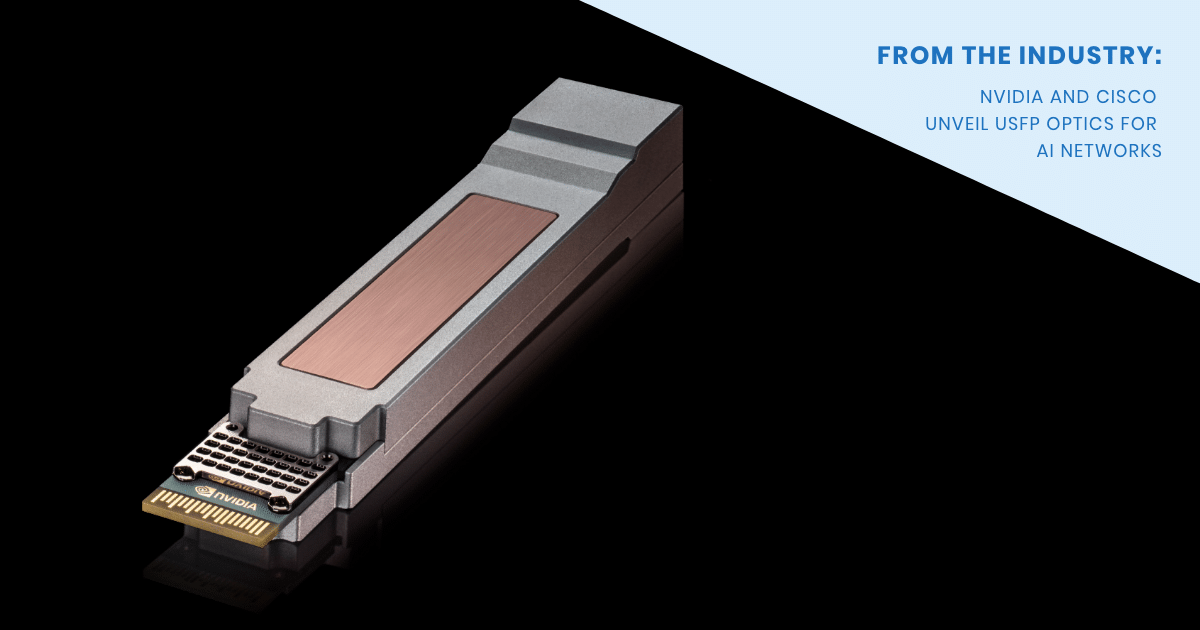
NVIDIA and Cisco have announced Ultra-Dense Small Form Factor Pluggable (USFP), a new optical transceiver form factor designed for next-generation AI factories and high-performance Ethernet networks. Supporting 400 Gb/s per electrical lane, USFP promises four times higher bandwidth density and approximately 1.3x greater power efficiency compared with today's 200 Gb/s-per-lane pluggable optics.
Announced on October 12, 2026, at the Open Compute Project (OCP) Global Summit, USFP aims to address growing bandwidth, power, and scalability challenges in AI data centers, GPU clusters, and large-scale Ethernet fabrics.
USFP: 400 Gb/s per Lane and Up to 12.8 Tbps
The first planned USFP transceivers will integrate 16 full-duplex lanes operating at 400 Gb/s each, delivering 6.4 Tbps of bandwidth per direction in an OSFP-sized footprint. Future 32-lane configurations could increase this capacity to 12.8 Tbps.
Key technical features include:
- 4x higher bandwidth density compared with existing 200 Gb/s-per-lane pluggable modules.
- Approximately 1.3x improved power efficiency, helping reduce networking power consumption.
- Up to 100 W power dissipation without a dedicated embedded cooling circuit.
- New two-dimensional connector design with two-step insertion for improved signal integrity and reduced contact wear.
- Support for switches and SuperNICs, enabling higher-density connectivity for 1.6 Tbps endpoints.
- Pluggable, field-replaceable architecture, preserving operational flexibility in data center networks.
Scaling Data Center Networks Beyond Today's Limits
As GPU clusters and AI workloads grow, network operators must increase Ethernet fabric bandwidth without continuously adding switches, optical links, and network tiers.
USFP could help data center operators build higher-capacity spine-leaf networks, connect more AI accelerators per switch, and improve infrastructure utilization while reducing latency and power requirements.
For network engineers, this development also highlights the growing importance of high-speed network monitoring, traffic visibility, congestion management, and network performance troubleshooting.
As Ethernet fabrics scale toward multi-terabit connectivity, maintaining visibility into network traffic and detecting anomalies will remain essential for reliable AI infrastructure operations.
NVIDIA and Cisco Build an Open USFP Ecosystem
NVIDIA and Cisco are working with TE Connectivity and Amphenol on USFP connectors, cages, and optical modules.
The companies also plan to establish an open industry specification through a community-led multi-source project, encouraging broader adoption of high-density pluggable optics.
The initiative complements NVIDIA Spectrum-X Ethernet networking and Cisco Silicon One-based Ethernet platforms, targeting hyperscale data centers, cloud providers, neoclouds, and enterprise AI infrastructure.
What Comes Next?
USFP is still a planned technology, and its commercial availability and broader vendor adoption remain to be seen.
However, its proposed combination of 400 Gb/s-per-lane signaling, 6.4 Tbps initial capacity, and a roadmap to 12.8 Tbps represents a significant development for next-generation Ethernet switching and AI factory networking.
For network operators, the challenge will be ensuring that network observability, operational reliability, and traffic management evolve alongside these rapidly increasing bandwidth capabilities.
Sources: